Wine tax and compliance
Your wine tax returns, filed.
Pinrates prepares your state sales tax and wine excise returns from your orders. We file them electronically in California, Florida, Indiana, North Carolina, Ohio, and Wisconsin, and add states as we pass each one's e-file testing. In 26 more states your return is prepared and ready to submit, with the state's portal one click away.
Filing starts at $299 a month per winery. Shipment checks are free.
Upcoming returns
Hollow Oak Cellars · example account · 4 states
California sales and use tax
Quarterly · Q3 2026 · CDTFA
Filed electronicallyPennsylvania PLCB sales report
Quarterly · Q3 2026 · PLCB+
Ready to submitFlorida sales and use tax
Monthly · Oct 2026 · Florida eFile
Filed electronicallyOhio sales and use tax
Monthly · Oct 2026 · OH|TAX
Filed electronicallyPennsylvania wine excise
Quarterly · Q4 2026 · myPATH
Ready to submit6
states where we file your returns electronically
32
states where Pinrates prepares your returns
$0
difference from filed tax in our 2025 California recalculation
50 + DC
covered by free shipment checks
Your California return, filed and paid in one step
If you sell wine from California, you file the CDTFA-401. By hand, that means pulling the quarter's sales out of your systems, separating retail from wholesale and California deliveries from shipments out of state, working out district tax, then keying every line, the district schedule and the payment into CDTFA Online Services. In Pinrates it is one screen.
- Built from your sales. Pinrates builds the return as sales come in, direct-to-consumer and wholesale. Every line traces back to the sales behind it: wholesale is deducted with each buyer's license on file, and the district tax schedule (Schedule A2) comes from each delivery address.
- Reviewed on one screen. You see each line beside the draft it came from, and the whole return laid out as CDTFA's own form.
- Paid with the return. CDTFA debits your bank account on the day you choose, up to the due date. There is nothing to pay at CDTFA's site.
- Filed when you click File. Confirm, and CDTFA's answer comes straight back: the confirmation number is recorded on the return, and the filed copy is kept with it.
← Filings
California sales and use tax (CDTFA-401-A)
Hollow Oak Cellars · CDTFA-401-A2 · Q3 2026 · due Oct 31, 2026 · files with CDTFA by Direct Transmit
The return
| Draft | Filed with CDTFA | |
|---|---|---|
| Line 1: Total sales | $412,860.37 | $412,860.00 |
| Line 4: Sales for resale (wholesale) | $18,240.00 | $18,240.00 |
| Line 8: Sales shipped out of California | $236,415.12 | $236,415.00 |
| Line 11: Total nontaxable transactions | $254,655.00 | |
| Line 12: Transactions subject to tax | $158,205.25 | $158,205.00 |
| Line 13: State tax (6%) | $9,492.00 | |
| Line 14: County tax (0.25%) | $396.00 | |
| Line 15: Local tax (1%) | $1,582.00 | |
| Line 16: District tax (Schedule A2) | $1,604.00 | |
| Line 17: Total tax | $13,074.26 | $13,074.00 |
| Line 18: Excess tax collected | $12.40 | $12.00 |
| Amount due | $13,086.66 | $13,086.00 |
Schedule A2: $134,339.00 across 31 district areas, $23,866.00 at the state rate only, district tax $1,604.00.
See the orders →The return as CDTFA's form (PDF) ↗
Payment
CDTFA debits $13,086.00 from checking ****4417 (Hollow Oak Cellars LLC) on Friday, October 30. Authorized by Dana Ruiz. There is nothing to pay at CDTFA's site.
Debit on 10/30/2026 Any banking day up to the due date: CDTFA refuses a date after it.
File
Try the File button: Hollow Oak Cellars is a fictional example account, and nothing is sent.
Pinrates is a CDTFA-certified Direct Transmitter for California sales and use tax returns (CDTFA-401-A2). Certification means we showed in CDTFA's testing that we transmit return data correctly; it is not an endorsement by CDTFA.
What we file for you
Most wineries shipping direct to consumers owe returns to several agencies, on different schedules, through different portals. Pinrates prepares them from the same order data, and tracks what you owe in each state, how often, and when it's due next.
State sales and use tax
State and local rates, calculated from each delivery address.
State wine excise
Excise for each state you ship to, at the right rate for still, sparkling and higher-alcohol wine.
State shipper reports
The volume and sales reports some states require, like Pennsylvania's quarterly PLCB report.
Wholesale
Your wholesale sales on your California return, each deducted with the buyer's license on file. For distributors, Florida's monthly distributor report.
Where we don't file electronically, Pinrates prepares the figures for you to submit. Every portal you file in, for sales tax, excise, annual reports, renewals and label registrations, is one click away in your account, with your login beside it.
See how every number was calculated
Most compliance tools tell you a return is done. Pinrates shows you the return line by line, with the rate and source behind each figure. If a state asks why you charged $94.55 on a shipment eighteen months ago, you can show them exactly how it was figured.
Because we calculate each return from the individual orders, we catch problems that totals-only tools miss, like a local rate that changed mid-year or a wine taxed at the wrong rate.
Each figure links to the rate and source in effect on the sale date.
When we recalculated a year of a California winery's returns, our tax due matched the filed amount to the dollar.
Filed electronically, with more states on the way
Where a state accepts electronic filing from us, Pinrates submits your return directly. Everywhere else, the return or its figures are ready for you, your login is stored securely, and the right portal is one click away.
- Filed electronically: California, Florida, Indiana, North Carolina, Ohio, and Wisconsin
- Coming next: Georgia, Illinois, Michigan, Nevada, and Texas, prepared for you until then
- Prepared for you: 21 states
- Due dates tracked: 16 states
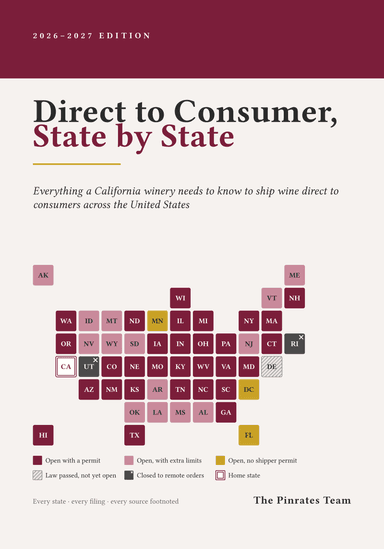
- Not open to direct shipping: Delaware, Rhode Island, and Utah
Free book
Every state's rules, in one free book
Direct to Consumer, State by State gives a California winery a chapter for every state and DC: whether you can ship there, what you file, and every rule footnoted to its source. Each state's page on pinrates.com carries any change since the book went to press.
477 pages · PDF · version 1.1 · More about the book
Built from your orders, not a spreadsheet
Compliance work often means pulling reports out of Commerce7 every month and rebuilding them in a spreadsheet. Pinrates brings in your Commerce7 order history when you start, and new orders from Commerce7's standard order export after that. Each return is built from the individual orders, not from totals someone retyped.
Everything a state might ask for, in one place
Each state you ship to has its own page in Pinrates: your licenses, the rules that apply, your filing schedule, and your login for the state portal.
State logins, stored safely
Passwords are encrypted with a key that isn't kept in our database, and every time someone views one, it's recorded.
Conversations with the state
When someone calls a state agency and gets an answer, log it. The answer stays with your account even if the person who made the call moves on.
A full history for audits
Every shipment check and return is saved with the rates and rules in effect at the time.
The rest of your compliance work
Filing is the biggest job, but not the only one. Pinrates also helps with:
- License renewals, with each permit's renewal date on your calendar
- Label and brand registration where a state requires it beyond your federal COLA
- Opening a new state, with a step-by-step checklist of the permits and registrations you need before your first shipment
Check any order before it ships, free
Before you file, every order has to be allowed in the first place. Pinrates checks each order as it's placed. If an order fails a check, it doesn't ship. If we're missing information, we tell you what we need instead of guessing.
License
Can you ship to this state, and is your fulfillment partner licensed there?
Product and buyer
Is the wine allowed, is the buyer 21 and verified, and is the order within the state's annual limit?
Tax
What's owed, based on the delivery address.
Who it's for
For wineries
Start with free shipment checks. Add filing from $299 a month, with every state you ship to on one calendar.
Talk to usFor compliance firms
Manage every client winery from one login, billed to your firm on one itemized invoice. $239 per client a month for your first 10 clients, and less per client as your book grows. Add clients yourself; they can claim their own account anytime.
See the firm planPricing
Shipment checks
Free
License, product, buyer and tax checks on any order, with the full explanation.
Ask for free checksPrepare
$299 / month
or $2,990 paid yearly
We prepare your returns. You submit the ones we don't file electronically.
Talk to usManaged
$899 / month
or $8,990 paid yearly
We prepare and submit your returns, in every state you ship to.
Talk to usConcierge
$1,250 / month
or $12,500 paid yearly
We also open new states and register your labels.
Talk to usPay annually and get 2 months free. State filing, permit and registration fees are passed through at cost. No setup fees and no per-user charges.
Compliance firms: $239 per client a month for your first 10 clients, $199 for clients 11 to 25, and $169 beyond that. Each client gets the Prepare plan; pay yearly and get 2 months free.
See the firm planHow we keep our numbers right
- Every number has a source. Each rate links to the state publication or schedule it came from.
- Rates come from the states' own files. Where a state publishes rate and boundary files, we load them as published and dated, so each order uses the rate in effect on the day it was sold.
- We test against filed returns. We recalculate returns already filed with a state, order by order, and work through every difference before we rely on the figures.
- We don't guess, and nothing is overwritten. If information is missing, Pinrates says what it needs instead of filling in a default. Every check and return is saved with the rules used at the time, so you can show an auditor exactly what happened years later.
Let us handle the returns.
Talk to us about free shipment checks, or about moving your filing to Pinrates.